API-First or Platform-First B2B Data Strategy: Which Scales Better
APIs serve machines with instant data. Platforms serve people with interfaces. Learn when each scales better for AI agents, costs, and governance.
Published
Written by
Chris P.
Reviewed by
Nithish A.
Read time
7
minutes
A B2B data API is a technical interface for instant, programmatic data exchange. It delivers structured data directly to machines. A B2B data platform is a software application that combines APIs with user interfaces. It provides a centralized hub for human data management.
APIs are for machines that need to act fast, like an AI agent. Platforms are for people who need to see data in a dashboard. Most mature teams eventually move toward a hybrid model. They use APIs for instant triggers and platforms for human oversight. The real challenge is making sure both systems return the same answer so your data remains accurate.
In this article, we will break down which strategy scales better for your specific needs. We will analyze the unit economics of each model to help you avoid hidden costs. You will also learn how to evaluate vendors based on data freshness and reliability.
What is the difference between API and platform in B2B data?
A B2B data API is a set of protocols that enables software applications to programmatically access and integrate real-time business information into their own systems or workflows. In this model, the product is the data itself, delivered via REST APIs, webhooks, or bulk flat-file dumps. Engineers and data scientists are the primary users because they need to build custom enrichment loops or predictive models.
A B2B data platform is a centralized software solution or interface designed to aggregate, manage, and provide searchable access to detailed business databases for sales, marketing, and recruitment teams. Here, the data is a component of a larger software experience. The platform bundles information with visual dashboards and prebuilt connectors. Sales reps and marketers usually use platforms to visualize prospects and push lists to a CRM without writing any code.
The goals of platforms differ widely from those of standalone APIs:
APIs focus on machines: They are engineered for event speed and high-frequency automated tasks.
Platforms focus on people: They prioritize ease of use and strategic oversight for human teams.
Data delivery varies: APIs excel at real-time triggers, while platforms often operate on periodic batch updates.
Integration requirements differ: APIs require developer expertise to manage connections, but platforms offer ready-made tools for non-technical users.
This functional difference drives every trade-off you will face. Choosing between them impacts your pricing model, how fast you can scale, and what your team can realistically build.
Which approach scales better for AI agents?
API-first strategies scale significantly better for automated and AI-driven workflows. They decouple costs from headcount and enable the high-volume programmatic access required for modern growth. While a platform is a great starting point for human-led tasks, APIs provide the low-latency infrastructure AI agents need to operate without a user interface.
To determine which of these approaches works best for you, we will need to assess scalability from multiple angles, including cost, volume, and data freshness.
The scalability tax of platforms
Choosing a platform-first model often introduces hidden costs that stall growth as your team expands. Because platforms frequently tie costs to seats, every new hire or AI agent adds a new license fee to your budget.
Seat-based pricing creates a step-function cost curve. Scaling your operations requires large capital injections every time you add a team member.
Credit limits cap your output. Most platforms limit the number of records a team can export, resulting in steep overage charges or forced upgrades to higher tiers.
AI agents expose these limitations. An AI SDR can process thousands of leads every hour, a volume that would require an army of human reps on a platform model.
Rate limits throttle performance. Platforms are often built for human clicking speeds, which can slow down the high-volume processing that AI excels at.
The volume economics of APIs
Usage-based pricing typically ties your costs to actual output rather than your headcount. A single engineer managing one API connection can facilitate the enrichment of millions of records without needing more "seats".
Cost per record decreases at scale. Unlike the "seat tax" that rises with every user, API costs often become more efficient as your volume increases.
Architectures support programmatic prospecting. Triggers like funding rounds or job changes can automatically start outreach sequences without any human intervention.
Integration is built for machines. APIs deliver high-frequency, structured data that AI models need for automated decision-making.
The freshness factor at scale
Scale is only valuable if your data is accurate. Scaling stale data is counterproductive because it increases the rate of incorrect emails sent to the wrong people.
Many traditional data providers update their databases only once a month or once a quarter. If a prospect changes jobs on the 1st of the month, they might not show up in the database until the 30th. Any outreach sent in between those dates is based on wrong information, which can damage the sender's reputation.
Real-time APIs solve this by performing live crawls at the exact moment you make a request. This reduces data latency to near zero and enables event-driven sales strategies. AI workflows depend on these real-time signals:
AI SDRs need immediate updates. They must know about role changes today to trigger relevant outreach before competitors arrive.
AI recruiters find candidates instantly. They surface new talent the moment a profile becomes available online.
AI investment tools flag growth early. They track headcount surges and funding events to catch opportunities before they become common knowledge.
Crustdata's Watcher API inverts this entire model. Instead of pulling data by searching for leads, it pushes notifications to you the moment a trigger happens. This provides the infrastructure scalability required for true AI-powered workflows without sacrificing data accuracy.
How delivery method shapes what you can build
The way you receive data determines what your software can actually do. While the "API vs. platform" debate often focuses on technical specs, the real impact is on your product's capabilities.
B2B Data: APIs vs. Platforms
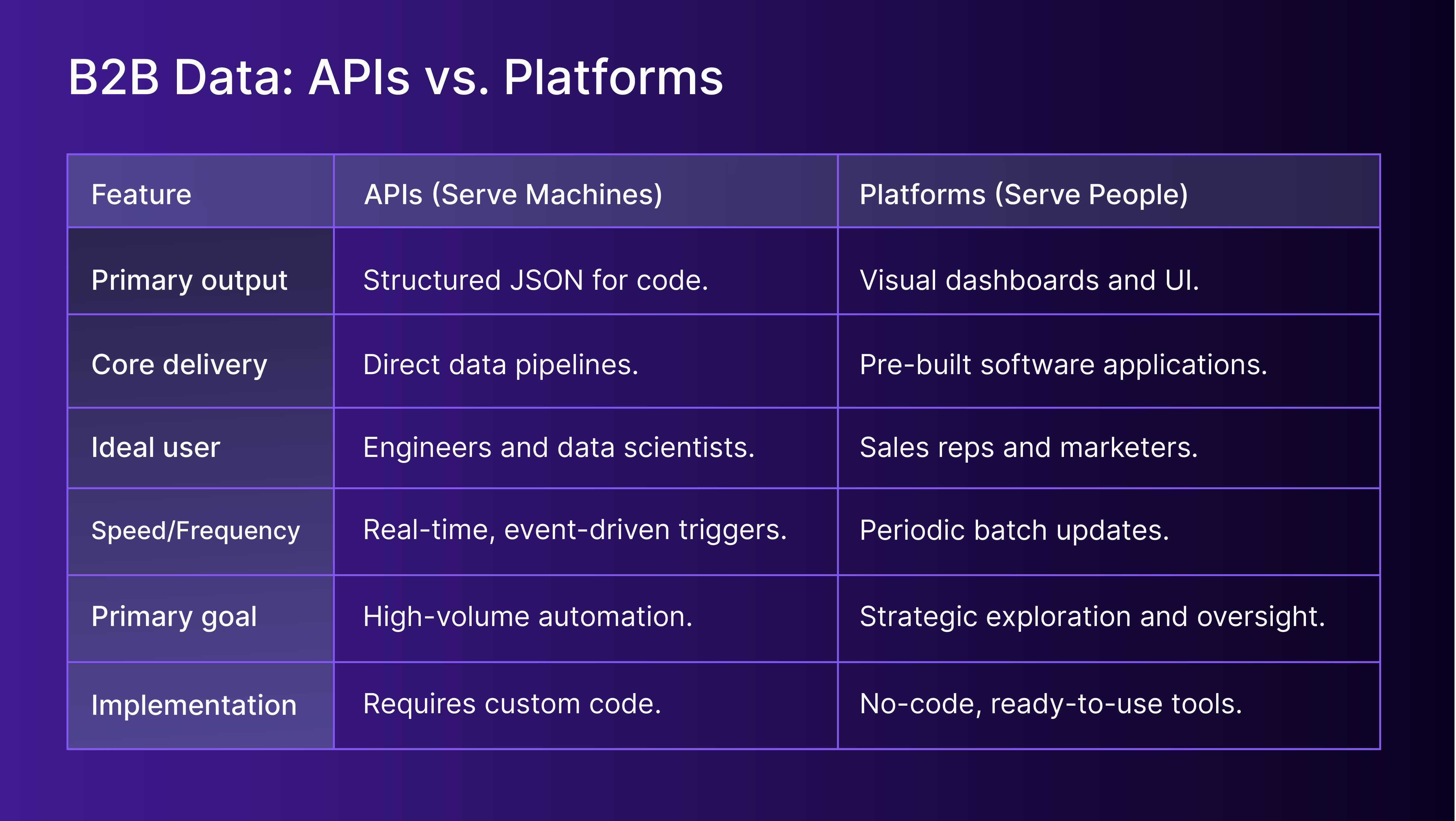
APIs serve machines
APIs deliver structured, machine-ready JSON for automated systems like pricing engines, BI dashboards, and AI agents. By providing data directly to your code, APIs ensure your architecture is decoupled from any specific application layer.
Enable programmatic prospecting. Triggers automatically initiate enrichment and outreach sequences without human intervention.
Support event-driven sales. A role change signal lands via webhook, allowing your system to fire outreach before competitors even know a change occurred.
Facilitate custom enrichment loops. Engineers can pipe data into any internal tool without the constraints of a pre-built user interface.
Empower data scientists. Technical teams use APIs to build predictive models and custom tools that require high-volume data streams.
Platforms serve people
Platforms bundle data with visual dashboards, search interfaces, and workflow tools designed for non-technical users. The value is delivered through an interface where data is a component of the software experience rather than just a raw utility.
Enable human exploration. Sales reps can log in to search for companies matching an Ideal Customer Profile (ICP).
Support manual validation. Managers use platforms to view org charts and verify contact details before starting a campaign.
Simplify list building. Users can filter through millions of records and "unlock" specific contacts with a few clicks.
Streamline executive reporting. Platforms provide charts and insights that help leaders understand their target market trends without writing code.
Choosing the right delivery method is about choosing your primary consumer. If you are building for marketing automation, an API-first strategy provides the flexible ingredients you need to scale. If you are building for a human sales team, a platform provides the structure they need to succeed.
When should I use APIs vs platforms?
Use case | Best choice | Why |
AI Agents & SDRs | API-first | Delivers structured JSON for high-volume, automated workflows. |
Sales prospecting | Platform-first | Provides visual dashboards for human exploration and list building. |
Real-Time triggers | API-first | Webhooks deliver updates within 100ms for instant event action. |
Executive reporting | Platform-first | Simplifies data into charts and insights for strategic oversight. |
Bulk enrichment | Bulk datasets | Offers predictable pricing and local access for large-scale CRM updates. |
Criteria for choosing your approach
Three key factors determine which approach fits your needs:
Team resources and technical capacity. You must decide if you have the engineering talent to manage API integrations or if your team needs a user-friendly platform.
Data freshness and volume requirements. Some projects need real-time updates through webhooks, while others work fine with bulk datasets.
Total cost of ownership. You should look beyond the sticker price to find hidden costs like API overage fees or seat-based licensing.
Most teams eventually discover they need elements of both to succeed. The real question is how to combine these delivery methods without creating governance chaos or having two versions of the truth.
Team skills and technical resources
Choosing between an API and a platform depends heavily on your internal capacity to build and maintain technical systems.
Implementing an API-first strategyAPI-first strategies require backend engineers to build and manage the entire data infrastructure. This path is ideal for teams building custom tools, but it comes with specific resource requirements:
| Launching with a platform-first strategyPlatform-first models need minimal technical resources because the interface is pre-built. A Sales Ops admin can often configure integrations, allowing team members to begin working on the first day.
|
If you find that API-first tools like Crustdata, People Data Labs, or Coresignal are too developer-focused, a platform-first approach is a strong alternative. API-only providers often lack a native prospecting interface, meaning sales reps cannot log in and search for leads directly. To use an API for a sales team, an organization would first need to hire engineers to build an internal sales tool. For teams without a dedicated engineering budget, a platform provides the ease of use needed to stay competitive.
Data freshness and volume requirements
Choosing the right delivery method depends on how fast you need to act on your data and how much of it you are processing. Scale is only valuable if the information is accurate; scaling stale data just means you are sending incorrect messages faster.
Determining your speed needs
AI agents and automated workflows often require real-time signals to be effective. For example, an AI SDR needs to know about a job change or a funding round within hours to trigger a relevant outreach sequence.
Real-time signals are critical for triggers. You need data updated within hours for hiring surges or role changes to beat competitors.
Monthly refreshes work for strategy. Quarterly analysis or bulk CRM population can often tolerate data that is updated every few weeks.
Live crawling ensures accuracy. Fetching data at the moment of request provides information that is accurate to the minute.
Pre-indexed data saves costs. Using a database that is already indexed returns results instantly and at a lower price point, though the data may be older.
Matching volume to economics
High-volume workflows typically favor the economics of an API because costs scale with your actual output. If you are enriching millions of records, usage-based pricing prevents the "seat tax" found in traditional platforms. Conversely, human-led prospecting with lower volumes may not justify the engineering time needed to build complex API infrastructure.
Real-time vs. pre-indexed trade-offs
The "freshness gap" is a major differentiator between B2B data API providers. While many claim to offer real-time data, there is a big difference between a monthly database refresh and live crawling.
Crustdata addresses this by offering both modes. You can use real-time crawling for instant signals where freshness is the top priority, or choose the pre-indexed database for less time-sensitive tasks that require more filters at a lower cost. The key question is whether you are acting on signals within hours or if weekly data is acceptable for your specific workflow.
Implementation costs and maintenance
Calculating the total cost of ownership (TCO) for your data strategy requires looking past the sticker price. You must weigh engineering hours, potential overages, and the cost of infrastructure against the value of the data.
Understanding API cost patterns
Usage-based pricing aligns your expenses directly with the value you receive. This model is often more economical for high-throughput automated workflows because your cost per record typically decreases as your volume grows.
Credit-based pricing connects cost to output. You pay only for what you actually use rather than paying for idle capacity.
Optimization is key to controlling spend. Implementing deduplication logic and caching helps prevent duplicate requests that burn through your budget.
Usage models simplify forecasting. Transparent pricing makes it easier to predict monthly expenses compared to opaque enterprise quotes.
Endpoint costs vary. Different data requests may consume different credit amounts, so you should model your expected usage before committing to a plan.
Navigating platform cost patterns
Flat-rate subscriptions offer high predictability, which suits human-led teams with steady workflows. However, these models often hide secondary costs that can inflate your final bill.
Watch for expensive add-ons. Extra seats, regional data access, and premium features often require additional fees not included in the base price.
Costs compound with headcount. The per-seat model works well for stable teams, but it becomes expensive as you hire more people or deploy more AI agents.
Credit limits still apply. Many platforms charge steep overage fees if your team exceeds their monthly data access allowance.
Bulk data as a cost-effective alternative
Monthly flat-file datasets delivered via S3 buckets offer a middle ground. These provide local access speed with no per-call charges, making them ideal for large-scale enrichment where periodic refreshes are acceptable.
Predictable costs for large datasets. You pay a flat license fee to access the entire database locally.
Trade-off on freshness. While economical for historical analysis or CRM population, bulk data is not suitable when agents need to act on signals immediately.
The key to a successful strategy is understanding your true TCO. This includes the engineering time needed for integrations and the infrastructure required to manage real-time webhooks.
Get started with Crustdata
Teams building innovative B2B products now need a flexible approach that provides the right delivery method for every specific use case. Crustdata’s multi-modal delivery ensures your data architecture scales without the common headaches of governance chaos or runaway costs.
For teams building AI agents and automated workflows
If you are building AI SDRs or autonomous agents, speed is your primary competitive advantage. Crustdata is designed to serve machines with the instant, structured data they require.
Real-time APIs deliver signals instantly. You get maximum accurate coverage to find all the people or companies that meet your criteria, and filter further to identify the exact fit for your requirements.
Watcher webhooks eliminate polling. Your system gets notified the moment a trigger happens, allowing you to act while competitors are still using stale data.
Consistent schema across all sources. We aggregate data from 10+ platforms into a single, structured JSON format with intelligent entity resolution – so your automated workflows receive clean, predictable data without the schema drift that breaks pipelines.
Engineering support speeds up your build. While API-first strategies often require heavy engineering resources, we provide hands-on support to help you build your product and make integration as easy as possible.
For cost-conscious and strategic teams
Scalability should not come with a "seat tax" or hidden fees. We provide multiple ways to access data so you can match your spend to your actual business value.
Bulk datasets provide predictability. Large-scale enrichment projects benefit from flat-rate pricing and local access speeds.
Transparent pricing avoids surprises. Our credit-based model means no opaque negotiations or unexpected add-ons to your bill.
Stop compromising between speed and budget. Book a demo today to see how Crustdata's multi-modal delivery can provide the perfect data foundation for your next project.



Products
Popular Use Cases
Competitor Comparisons
95 Third Street, 2nd Floor, San Francisco,
California 94103, United States of America
© 2026 Crustdata Inc.
Products
Popular Use Cases
Competitor Comparisons
95 Third Street, 2nd Floor, San Francisco,
California 94103, United States of America
© 2026 CrustData Inc.
Products
Popular Use Cases
Competitor Comparisons
95 Third Street, 2nd Floor, San Francisco,
California 94103, United States of America
© 2026 Crustdata Inc.