What Is a Lead Enrichment API and How Does It Work?
Discover what a lead enrichment API is so you can automate prospect research, improve data quality, and help your sales team reach the right buyers.
Published
Written by
Chris P.
Reviewed by
Nithish A.
Read time
7
minutes
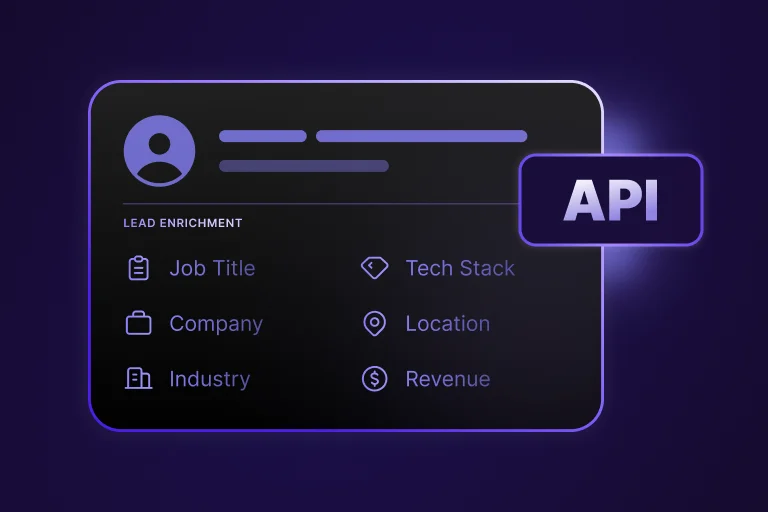
Sales reps often spend hours researching prospects before sending a single email, digging through company websites and funding announcements to figure out who they’re talking to and whether the timing makes sense.
According to Salesforce’s State of Sales report, sales professionals spend only 28% of their time actually selling and use the rest for research and administrative tasks. Lead enrichment APIs cut that research time by automatically filling in missing data as soon as a prospect enters your system.
This guide answers the question: “What is lead enrichment API?”, and breaks down how it works, what data it returns, and how it integrates into your existing sales workflow.
Key Takeaways
Lead enrichment APIs automate contact research
Feed an email address or domain to the API and get back structured data on job title, company size, revenue, industry, and tech stack in seconds, without manual lookups.
Real-time vs. database enrichment affects data freshness
Real-time APIs crawl sources with each request, capturing recent job changes immediately. Database providers query pre-compiled records updated monthly or quarterly.
APIs integrate directly into existing workflows
Enrichment happens automatically when leads enter your CRM or submit forms, eliminating manual CSV uploads and batch-processing delays that slow sales response times.
Crustdata crawls data in real time
Instead of querying static databases, Crustdata pulls fresh information at the moment of each request and sends webhook alerts when contacts change jobs or companies raise funding.
What Is a Lead Enrichment API?
A lead enrichment API takes incomplete contact information and returns structured business data about a specific person and their company. You send an email address or domain through an HTTP request, and the API queries multiple data sources to return job titles, company size, revenue, funding status, tech stack, and contact details in JSON format.
The difference from manual enrichment tools comes down to integration. Instead of uploading CSV files to a web interface and waiting for batch processing, the API runs inside your application code or CRM workflow. When a lead fills out a form on your website, the enrichment happens instantly before the record hits your database. Your sales team sees complete profiles without switching between tools or waiting for overnight batch jobs to finish.
Most enrichment APIs work with minimal input. Feed it with just an email address, and you get back 20 to 50 data points covering:
The person’s role
Seniority
Department
Industry
Company size
Location
Revenue range
Some APIs require a company domain to return firmographic data, while others can match records using names and company combinations when email addresses aren’t available.
How Lead Enrichment APIs Work?
The API accepts an identifier in your HTTP request, typically an email address, company domain, or name/company combination. Your application sends this request to the provider’s endpoint with your API key for authentication.
The enrichment service queries its data sources to find matching records. Some providers maintain pre-compiled databases that get updated monthly or quarterly. Others crawl public sources in real time when you make the request, pulling fresh data from company websites, job boards, and public registries at that moment.
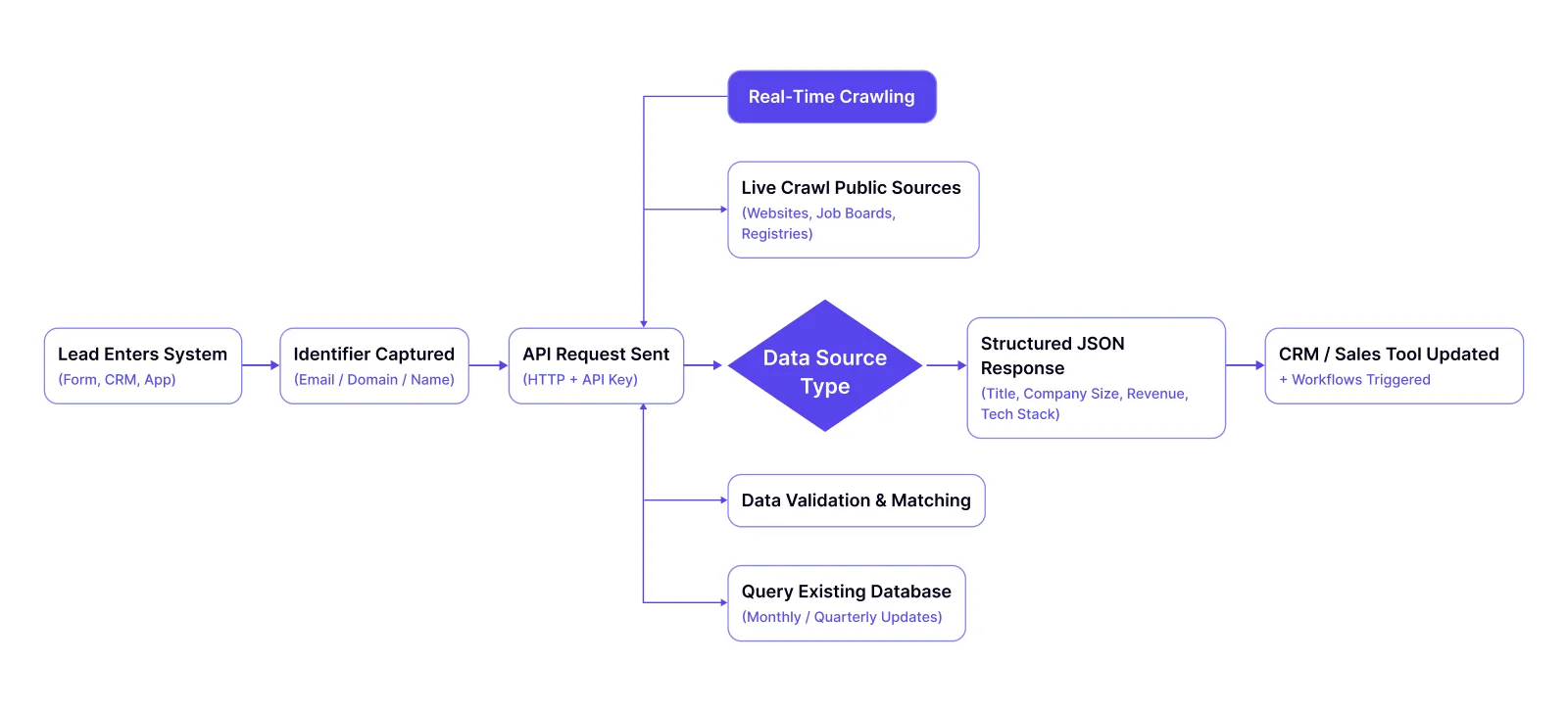
When the API finds a match, it validates the data against multiple sources to confirm accuracy, then structures the response in JSON format. The response typically includes:
Job title, department, and seniority level
Company revenue and employee count
Industry classification and location
Direct contact information
Tech stack and firmographic data
The API returns this data in seconds, and your system can immediately use it to update CRM records, trigger workflows, or score the lead for priority routing.
The quality of results depends on the input data you provide and the provider’s data coverage. An email address from a corporate domain typically returns more complete results than a Gmail address because the domain identifies the company. If the API can’t find a match, it returns an error code or partial data with confidence scores indicating which fields are verified.
Benefits of Using Lead Enrichment APIs
Lead enrichment APIs deliver specific advantages that change how sales teams work with prospect data:
Eliminates manual research time: Sales reps get complete profiles in seconds instead of spending 15-20 minutes per lead digging through websites and databases
Improves lead qualification accuracy: Company size, revenue, and job title data help you identify high-value prospects before anyone makes contact
Enables targeted outreach: Knowing a prospect’s tech stack, funding status, and role lets you reference specific pain points instead of sending generic messages
Keeps CRM data current: Real-time APIs catch job changes, acquisitions, and company updates automatically without manual cleanup work
Routes leads to the right reps: Revenue and employee count data send enterprise prospects to senior sellers while inside sales handles SMB leads
Integrates with existing tools: Enriched data flows directly into your CRM, marketing platform, or custom application without switching systems
Scales without adding headcount: APIs handle hundreds of enrichment requests simultaneously, maintaining speed as lead volume grows
Lead Enrichment API vs. Traditional Enrichment Tools
Traditional enrichment tools run through web interfaces where you upload CSV files, wait for batch processing, and then download the results. APIs enrich data the moment it enters your system through code that runs automatically.
The differences affect how fast you get data, what you pay, and how much control you have over the process:
Feature | Traditional Tools | Lead Enrichment APIs |
Processing Speed | Batch jobs run hourly or overnight | Real-time enrichment in 1-3 seconds |
Integration | Upload/download CSV files manually | Automatic enrichment via code |
Pricing Model | Monthly subscription or per-contact | Pay per API request |
Workflow Control | Fixed processing schedule | Custom triggers and conditions |
Technical Setup | Point-and-click interface | Requires developer integration |
Data Freshness | Depends on batch timing | Depends on provider (real-time or database) |
Use Case | One-time cleanups, bulk uploads | Product building and automation workflows |
APIs fit teams building automated systems where enrichment needs to happen without manual intervention. When a prospect fills out a form, the API returns complete data before your sales rep even sees the notification.
Traditional tools work better for marketing teams running occasional campaigns who need simple functionality without technical setup. You upload a list, wait for processing, and download enriched records when the job finishes.
The choice depends on whether you need instant enrichment integrated into your workflows or prefer handling enrichment as a separate batch process outside your main systems.
Common Use Cases for Lead Enrichment APIs
Lead enrichment APIs slot into sales and marketing workflows wherever incomplete data slows down decision-making or requires manual research. Below are the common use cases:
Sales prospecting and outbound campaigns: Reps start with basic contact lists and use enrichment to find decision-makers at target accounts. Job titles and seniority levels identify who controls budgets before the first contact happens.
Inbound lead qualification: When prospects submit forms with minimal information, APIs pull company size, revenue, and industry data to route high-value leads to senior reps while others enter nurture workflows.
CRM data cleanup: Existing databases accumulate outdated records as people change jobs or companies restructure. Periodic re-enrichment catches these updates without manual review.
Account-based marketing: Marketing teams identify multiple stakeholders within target accounts by enriching contact lists with role and department information, revealing engagement patterns across organizations.
Form optimization: Collect just email addresses upfront and let APIs fill in company details and job titles. Shorter forms convert better while you still capture complete prospect data.
AI agents and automation: Automated outreach systems reference enriched data about funding, tech stack, and growth signals to personalize messages without human intervention.
Lead scoring models: Enriched company size, revenue, and authority data feed into algorithms that rank prospects by fit and likelihood to convert.
How to Choose the Right Lead Enrichment API
Different providers specialize in different markets, data types, and refresh schedules. Your choice depends on which contacts you’re enriching, what data points you need, and whether you require real-time updates or can work with monthly database refreshes. Here’s what to consider when choosing a lead enrichment API:
Match rate and coverage: Test how many of your existing contacts the API can successfully enrich. Some providers excel at US enterprise contacts but struggle with international SMBs or specific industries.
Real-time vs. database queries: Confirm whether the API crawls fresh data on each request or pulls from pre-compiled databases. Real-time crawling costs more but prevents stale information from derailing outreach.
Data points returned: List exactly which fields matter for your workflows. APIs vary significantly in what they provide beyond basics like job title and company size. Some include tech stack and funding data, others don’t.
API response time: Test actual latency in your target regions. Sub-second responses work for real-time form enrichment, but slower APIs create noticeable delays that hurt user experience.
Documentation quality: Review the API reference before committing. Poor documentation turns simple integrations into week-long debugging sessions when error messages don’t explain what went wrong.
Webhook support: Check if the provider offers webhooks for job changes, funding announcements, or other trigger events. Polling APIs constantly waste resources compared to receiving alerts only when data actually changes.
Compliance and data sourcing: Verify where the provider sources data and how they handle privacy regulations. B2B data from public sources poses fewer compliance risks than consumer data.
Customer support quality: Check response times, availability of technical support, and documentation quality. Teams building products with APIs need reliable support to resolve integration issues and answer technical questions quickly.
Top 5 Lead Enrichment API Providers
The enrichment API market splits between providers who maintain pre-compiled databases and those who crawl sources in real time. Database providers offer faster responses and lower costs, while real-time crawlers deliver fresher data at higher price points. Here are some of the best lead enrichment API providers to consider:
Provider | Data Source | Best For | Key Feature | Starting Price |
Crustdata | Real-time crawling | AI agents, sales automation, recruiting platforms | Real-time enrichment via live crawling and custom webhooks for job changes, funding, and other signals | Custom pricing |
FullContact | Pre-compiled database | Marketing teams needing identity resolution | Unified people profiles with 900+ data attributes | Custom pricing |
ZoomInfo | Pre-compiled database | Teams needing extensive contact coverage | Direct dial numbers and verified emails | Custom (annual contracts) |
People Data Labs | Pre-compiled database | Developers building custom solutions | Granular person and company data | $0.02 per enrichment |
Cognism | Pre-compiled database | International teams needing EMEA coverage | Mobile numbers with strong European data | Custom enterprise pricing |
How Crustdata Helps with Real-Time Lead Enrichment
Most lead enrichment APIs query databases that are updated monthly or quarterly, so the job title you just pulled might be three months out of date. Crustdata crawls sources at the moment you make each request, pulling current data instead of serving cached records.
This matters when timing determines whether you reach prospects before competitors do. Real-time crawling captures role changes and company updates immediately by checking sources on demand rather than relying on scheduled database refreshes.
Crustdata delivers specific capabilities that separate it from database providers:
Crawls data in real time at the moment of request instead of querying monthly snapshots
Aggregates 250+ company data points and 90+ people data points from 10+ sources
Sends webhook notifications for job changes, funding rounds, executive hires, and hiring patterns through the Watcher API
Combines job postings, funding data, employee reviews, and social signals into unified records
Provides API-first architecture built for AI agents and automated workflows
The webhook functionality eliminates unnecessary polling. Subscribe to specific companies or contacts, and Crustdata alerts you the moment relevant changes occur rather than requiring repeated API calls to check for updates.
Need real-time B2B enrichment for your sales or recruiting platform?
Request a demo to see how live crawling compares to monthly database updates.



Products
Popular Use Cases
Competitor Comparisons
95 Third Street, 2nd Floor, San Francisco,
California 94103, United States of America
© 2026 Crustdata Inc.
Products
Popular Use Cases
Competitor Comparisons
95 Third Street, 2nd Floor, San Francisco,
California 94103, United States of America
© 2026 CrustData Inc.
Products
Popular Use Cases
Competitor Comparisons
95 Third Street, 2nd Floor, San Francisco,
California 94103, United States of America
© 2026 Crustdata Inc.