

Crustdata and SerpApi both return structured data via APIs, but they are built for very different purposes.
Crustdata delivers complete data infrastructure
SerpApi specializes in structured SERP extraction, returning search result JSON, ranking metadata, SERP features, and page screenshots across multiple search engines.
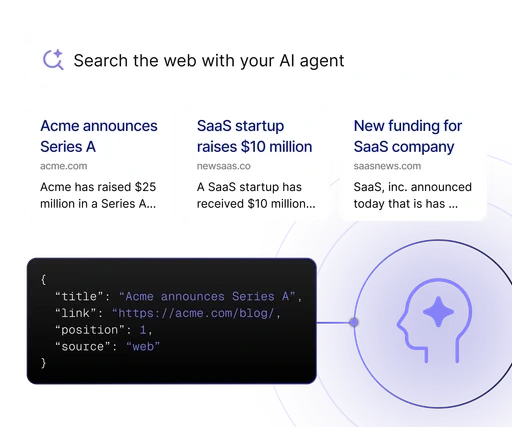
Crustdata’s Web Search API provides a unified endpoint across web, news, scholar, AI, and social sources, returning normalized JSON with built-in content fetching and native filtering. It’s designed for structured, multi-source research workflows.
| Feature | Crustdata | SerpApi |
|---|---|---|
| People profiles | web, news, scholar-articles, scholar-author, ai, social - all in one endpoint | Depends on engine |
| Social media search | ✅ | ❌ |
| AI-generated answers | ✅ | ❌ |
| Content fetching | ✅ (fetch_content=true fetches full webpage HTML for all results) | ❌ |
| Feature | Crustdata | SerpApi |
|---|---|---|
| Scholar support | Built-in scholar-articles, scholar-articles-enriched, and scholar-author sources | Via Google Scholar engine |
| Site restriction | Native site parameter | Via search operators |
| Date filtering | Native startDate / endDate (Unix timestamps) | Via search operators |
| Geolocation | 50+ country codes via simple geolocation param | Extensive (per-engine params) |
| Output format | Unified JSON across all sources | Highly structured JSON per engine |
Unified data access across multiple sources
SerpAPI focuses on structured extraction of individual search engine result pages. It provides APIs for many specific engines and services (Google Search, Images, Maps, Shopping, YouTube, Amazon, Walmart, and others), returning engine-specific JSON responses and SERP metadata such as ads, knowledge panels, rankings, and screenshots.
Crustdata’s Web Search API takes a different approach. Instead of exposing many individual engines, it aggregates results from multiple content sources, web, news, scholar, AI, and social, into a single unified endpoint and normalized JSON schema.
Websearch data coverage
SerpApi focuses on extracting search engine result page (SERP) features from individual search engines such as Google, Bing, YouTube, and others. It exposes many engine-specific APIs that return rankings, ads, knowledge panels, and other SERP metadata.
Crustdata’s Web Search API provides a unified search interface across multiple content sources, including web, news, scholar, AI, and social. Instead of exposing separate APIs for each engine, it returns normalized results through a single endpoint designed for programmatic discovery and downstream data workflows.
| Feature | Web Search | SerpApi |
|---|---|---|
| Search engines | Unified endpoint across sources | Multiple engine-specific APIs |
| Source types | web, news, scholar-articles, scholar-author, ai, social | Depends on engine |
| Scholar support | Built-in scholar-articles, scholar-articles-enriched, and scholar-author | Via Google Scholar engine |
| Social media search | Built-in social source | Not natively (separate engines) |
| AI-generated answers | Built-in ai source | Not directly |
| Content fetching | fetch_content=true fetches full webpage HTML | Returns SERP data only |
| Site restriction | Native site parameter | Via search operators |
| Date filtering | Native startDate / endDate | Via search operators |
| Geolocation | 50+ country codes via simple parameter | Engine-specific params |
| Output format | Unified JSON across all sources | Structured JSON per engine |
Structured entity intelligence vs SERP extraction
SerpApi provides real-time search engine result extraction. It is optimized for returning structured SERP data such as rankings, metadata, ads, and search features.
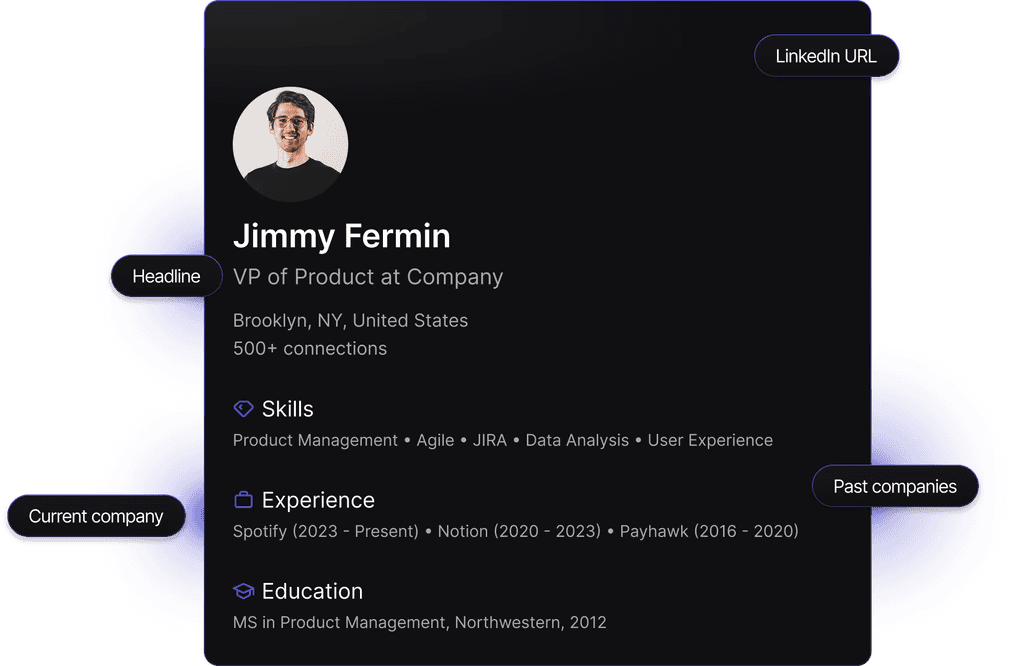
Crustdata goes beyond search result extraction. Its APIs return structured people and company entities enriched with additional context, including post activity, job postings, growth signals, funding history, and historical tracking.
See our websearch API in action
SerpApi solves the operational complexity of scraping. It handles browser emulation, IP rotation, dynamic rendering, and CAPTCHA resolution so developers can retrieve search engine results through a unified API. Crustdata is built to provide results from the web with APIs specifically built for AI agents. It also complements its structured B2B data APIs, providing an ecosystem for accessing all information about a person and a company from across the web.
The data is organized in a format designed for AI systems to understand easily, making it simple to enrich profiles, connect related entities, and monitor changes over time without additional parsing.
Built for powering products that need realtime data updates
SerpApi is built for extracting search engine result pages and returning structured representations of those results.
Crustdata’s APIs are built for products that depend on live structured data. From real-time enrichment to discovery and event tracking, it is the infrastructure layer designed for AI systems and platforms that require normalized intelligence instead of scraped HTML.
| Feature | Crustdata | Scrapin.io |
|---|---|---|
| Update frequency | Real-time (entity-level) | Live SERP fetch |
| Real-time monitoring webhooks | ✅ Yes | ❌ |
| Custom event tracking | ✅ Yes | ❌ |
Data freshness
SerpApi retrieves search results in real time whenever a query is made. Crustdata retrieves and monitors structured entities in real time and can trigger workflows when changes occur.
Not all search APIs are the same. SerpAPI focuses on extracting raw search engine results, whereas Crustdata transforms multi-source search into structured, entity-level data ready for enrichment, tracking, and AI-driven workflows.
You're building AI agents or automation that consume entity-level intelligence
SEO rank tracking, keyword monitoring, or SERP analytics is your primary use case
You need multi-source search (web + news + scholar + AI + social) in one call
You need deep pagination through large result sets
You need real-time monitoring and webhooks for entity changes
You need SERP feature extraction (ads, snippets, knowledge panels)
Your workflow combines search with enrichment, scoring, or competitive tracking
Crustdata replaces scraping infrastructure with structured, real-time intelligence designed for AI agents and modern data products.